Choosing the right irrigation system for your Osoyoos or Oliver property isn't just about keeping plants alive — it's about doing so efficiently under seasonal water restrictions while minimizing waste in one of Canada's hottest, driest climates. With hot summer temperatures, high evaporation during midday watering, and watering restrictions that can limit lawn watering days, your irrigation system design directly impacts water bills, plant health, and compliance with local bylaws. Here's how to choose the right system for your specific needs.
Understanding South Okanagan Irrigation Challenges
Our region presents unique conditions that affect irrigation system performance:
- Heat and wind: High summer temperatures combined with valley winds cause rapid evaporation — traditional sprinklers lose a significant amount of water to evaporation during afternoon watering
- Sandy soil: Valley floor soil drains quickly, requiring frequent watering or deep-root-zone delivery
- Water restrictions: Osoyoos and Oliver watering restrictions can change by season, year, and drought stage, so systems should be flexible enough to follow the regulations currently in effect
- Hard water: Mineral content can clog emitters and sprinkler nozzles without regular maintenance
- Freeze risk: Systems must be winterized before winter freezes to prevent damage — book your blowout in mid-September and have the system winterized by early October. Rocks N Blocks does not run blowouts in November.
Irrigation System Types: Pros and Cons
1. Traditional Spray Sprinkler Systems
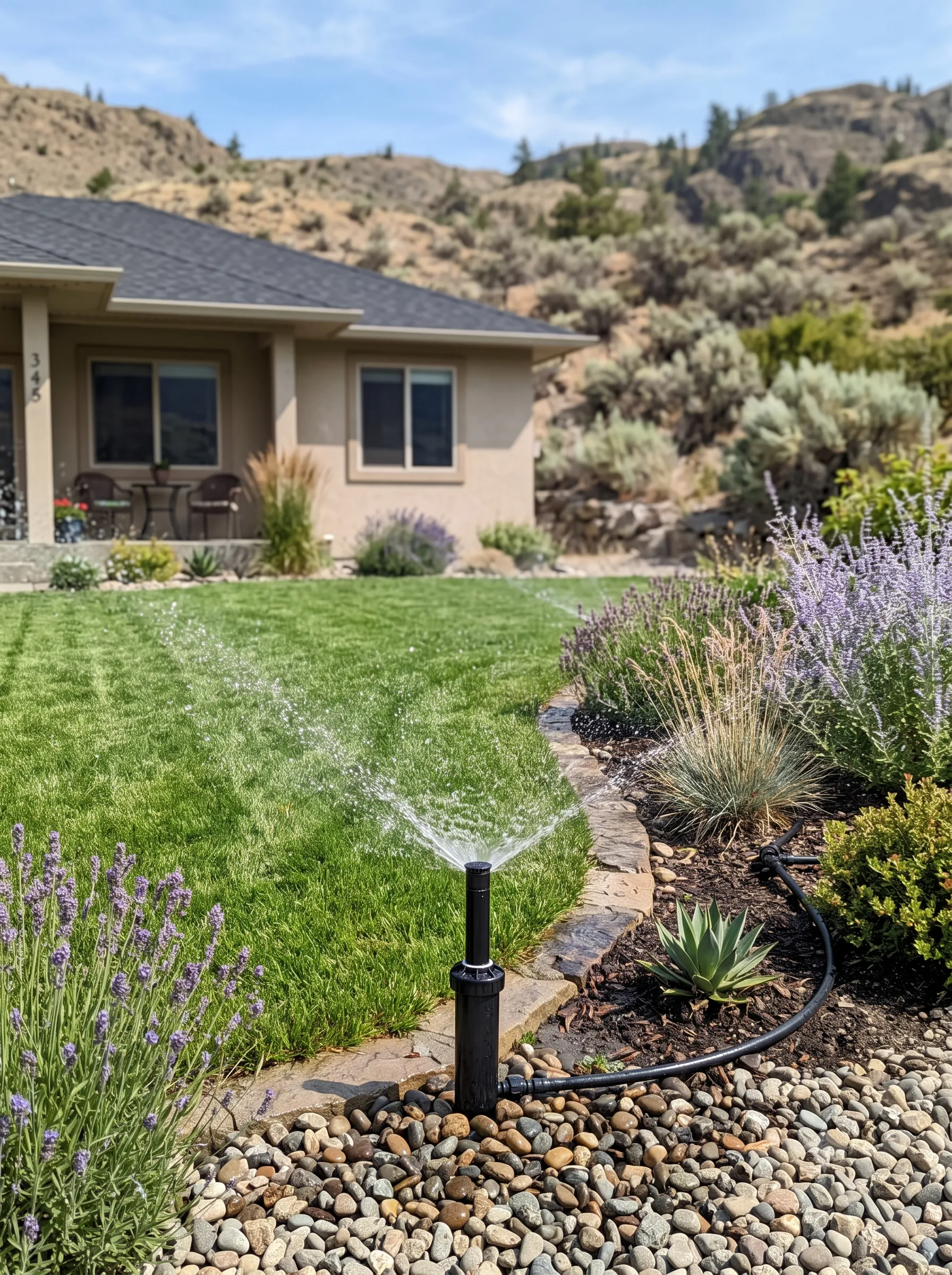
How they work: Pop-up spray heads distribute water in fixed circular or semi-circular patterns, covering 8-15 foot radius.
Best for: Lawns, groundcover beds, dense plantings
Pros: Lower installation cost, even coverage for turf, easy adjustment, parts readily available
Cons: Higher evaporation loss, overspray, wind drift, not ideal for water-restricted environments
Local recommendation: Best suited to lawn areas — optimize programming to reduce waste
2. Rotor Sprinkler Systems
How they work: Rotating heads distribute water in slow streams, covering 15-30+ foot radius.
Best for: Large lawn areas
Pros: Better wind resistance, efficient for large areas, lower precipitation rate, adjustable
Cons: Still loses some water to evaporation, slower application, higher initial cost
Local recommendation: Good for larger lawns; can be paired with a weather-based controller
3. Drip Irrigation Systems
How they work: Network of tubing with emitters delivers water directly to plant root zones at a low, steady rate.
Best for: Shrub beds, perennial gardens, vegetable gardens, hedges, xeriscape plantings
Pros: Minimal evaporation, delivers water directly to roots, reduces weeds, uses considerably less water than sprinklers, well-suited to restricted conditions
Cons: Higher installation cost, requires filtration, regular maintenance needed, not suitable for lawns
Local recommendation: Highly recommended for non-turf areas — one of the most water-efficient options
4. Micro-Spray/Bubbler Systems
Best for: Container plants, small shrubs, raised beds, trees
Local recommendation: A good middle-ground option for many plantings
Smart Controllers: An Option Worth Considering
Weather-based smart controllers can improve efficiency by adjusting watering schedules based on local weather data — skipping watering after rain, adjusting for heat waves, and reducing runtime during cooler periods. They cost more than standard programmable timers and require a reliable WiFi connection plus comfort with smartphone apps to be useful. For tech-comfortable homeowners who want a more hands-off system, they can be a worthwhile upgrade. For many Osoyoos and Oliver homeowners, a well-programmed standard timer does the job effectively at lower cost. Discuss your preferences and setup with your installer before committing to one.
Hybrid Systems: The Smart Approach
Most properties benefit from combining irrigation types:
- Zone 1-2: Lawn areas - Rotor or spray heads with programmable controller
- Zone 3-4: Shrub/perennial beds - Drip irrigation with pressure-compensating emitters
- Zone 5: Vegetable garden - Drip tape or inline drip tubing
- Zone 6: Trees - Drip emitters or bubblers with extended runtime
Installation Costs
Installation cost depends on property size, number of zones, system type, materials, access, and site conditions. A basic lawn system costs less than a full hybrid system covering lawns, garden beds, and containers. We provide a detailed estimate based on the specific property, system requirements, materials, site conditions, and scope.
Essential Features for South Okanagan Systems
Must-Haves
- Pressure regulation: Municipal water pressure is usually too high for drip, so pressure regulators are needed to bring it down to the correct range
- Filtration: A filter appropriate for the system to prevent emitter clogging on drip lines
- Backflow prevention: Required by bylaw, protects municipal water supply
- Rain sensor: Prevents watering during rain — simple, reliable, works with any timer
- Master valve: Adds extra shut-off layer, reduces water hammer
Highly Recommended
- Pressure-compensating emitters (consistent flow across elevation changes)
- Inline check valves (prevent low-head drainage)
- Flow sensor (alerts to leaks, broken lines)
- Valve boxes with locking lids (protects from rodents, damage)
Maintenance Requirements
- Spring Startup: Professional start-up — turn on slowly, check for damage, test zones, adjust heads, clear emitters. Spring startup timing depends on seasonal weather and conditions.
- During the Season: Keep an eye out for leaks, coverage problems, or damaged components, and address them as needed
- Fall Winterization (Mid-September to Early October): Professional blowout — book in this window, as we don't run blowouts in November. Compressed air removes water from the system to prevent freeze damage
Water Savings Potential
Drip irrigation uses significantly less water than spray systems — delivering water directly to root zones rather than spraying into the air where evaporation and wind drift waste a large portion. Hybrid systems combining spray heads for lawns and drip for garden beds offer the best overall efficiency for most South Okanagan properties. The exact savings depend on your property layout, plant types, and how your system is programmed.
Bottom Line Recommendations
For most Osoyoos and Oliver properties, the optimal setup is:
- Lawn areas: Rotor or spray heads with a programmable timer (or smart controller if you're tech-comfortable)
- Shrub/perennial beds: Drip irrigation with pressure-compensating emitters and filtration
- Trees: Individual drip emitters or bubblers
- Vegetable gardens: Drip tape or inline drip tubing
- Maintenance: Professional spring startup and fall winterization
Need help designing an efficient irrigation system for your Osoyoos or Oliver property? Rocks N Blocks specializes in water-efficient irrigation solutions tailored to South Okanagan conditions. Free consultations and system assessments: 250-485-8830.
Share this article:
Ready to Transform Your Landscape?
Get expert help from the team writing these guides. Free estimates for all Osoyoos and Oliver properties.