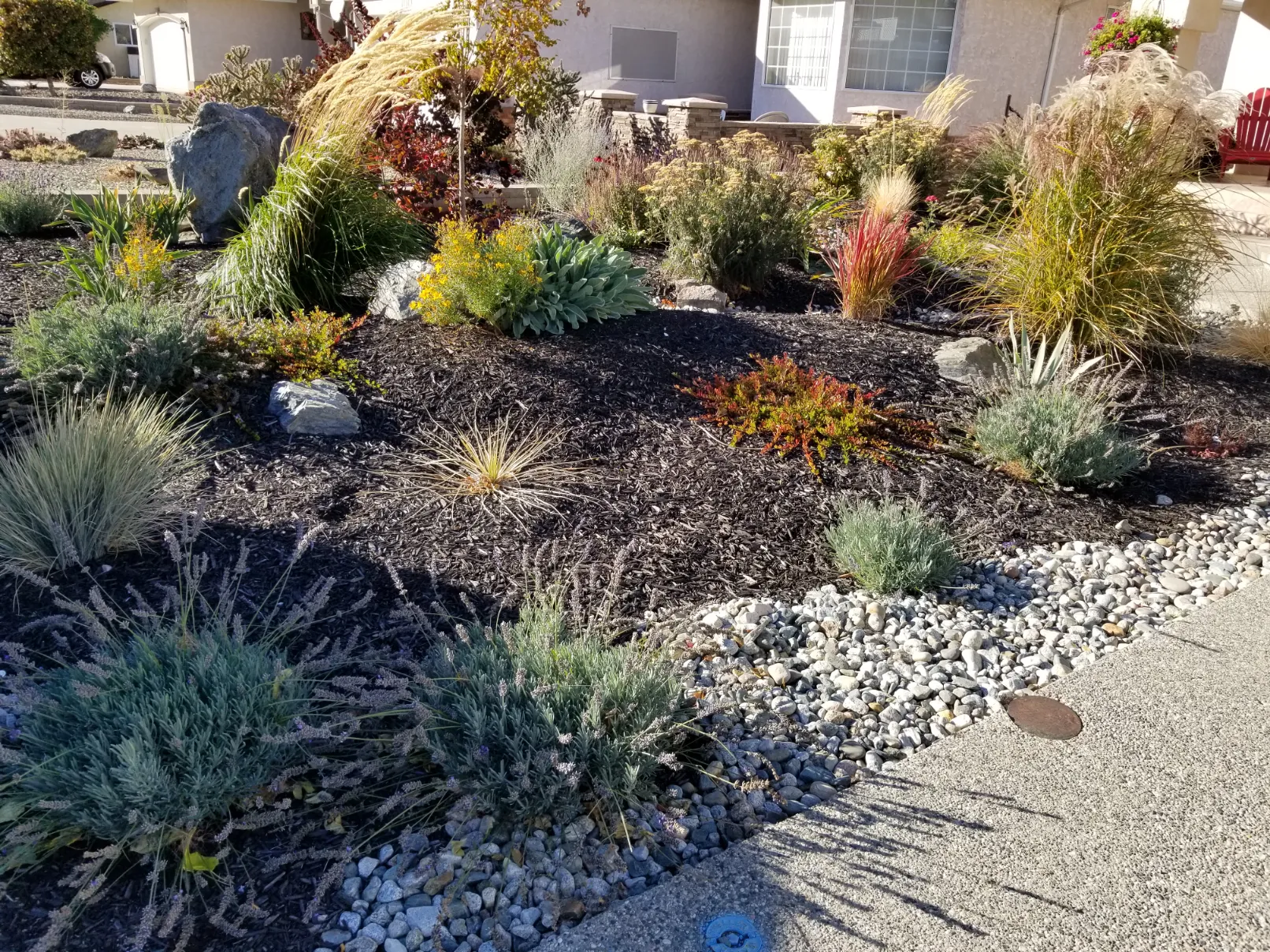
Xeriscape is one water-conscious landscaping approach South Okanagan homeowners can consider. With water shortages and seasonal restrictions in Osoyoos and Oliver, many homeowners are looking for beautiful outdoor spaces that don't require constant irrigation. Done right, a low-water landscape can be more visually interesting, colorful, and lower maintenance than traditional lawns and gardens. Here's how to create landscapes that embrace our climate instead of fighting it.
What "Xeriscape" Really Means — Two Common Meanings
Before going further, it helps to clear up terminology, because "xeriscape" is used two different ways locally:
- True xeriscape: A landscape built around drought-adapted and native plants that minimizes supplemental water once established. This is the strict definition of the term.
- What locals often mean by "xeriscape": Perennial and ornamental plantings set into decorative rock, usually over landscape fabric, with drip irrigation. This is a low-water, low-maintenance style — closer to what Rocks N Blocks commonly installs — but it isn't the same as true xeriscape.
Both are valid, water-conscious approaches, and this distinction shapes much of the advice below. When you talk to a landscaper, it's worth being clear about which one you have in mind.
Whichever approach you choose, xeriscape and low-water landscaping do NOT have to mean nothing but rocks and cacti, zero maintenance, or a barren, desert-like appearance. A well-designed low-water landscape can be lush, colorful, and beautiful while using considerably less water than traditional landscaping.
The Seven Principles of Xeriscape Design
1. Planning and Design
Assess your site conditions:
- Sun exposure (south/west faces get brutal afternoon sun in Osoyoos/Oliver)
- Soil type (most of South Okanagan valley floor is sandy loam)
- Existing trees/structures providing shade
- Wind exposure (north end of Oliver especially prone to winter/spring winds)
- Slopes and drainage patterns
Define zones by use and water needs:
- Oasis zone: Small area near patio/entrance with higher-water plants for visual impact
- Transition zone: Moderate-water perennials, small shrubs
- Xeric zone: Low-water plants once established, covering majority of property
2. Soil Improvement
Sandy South Okanagan soil drains quickly—too quickly for many plants. Improve before planting:
- Work compost into the native soil: Improves water retention without harming drainage
- For raised beds/planters: Blend compost into the soil, adding coarse sand where drainage needs improving
- Don't use peat moss alone: It dries out completely in our heat and is nearly impossible to re-wet
3. Practical Turf Areas
- Keep lawn in high-visibility, high-use areas (front yard, play area for kids/pets) and reduce it elsewhere — how much to keep depends on the property and how it's used
- Avoid strips of lawn: Narrow lawn strips along driveways/fences are water-inefficient and hard to irrigate evenly
- Choose sod suited to local conditions: Pick sod appropriate for South Okanagan heat and current local availability
4. Appropriate Plant Selection
This is where xeriscape gets interesting. Focus on plants native to similar climates: Mediterranean, Central Asian steppes, southwestern US. These thrive in Osoyoos and Oliver's hot, dry summers and cold winters.
5. Efficient Irrigation
- Drip irrigation for shrubs/perennials: Delivers water directly to roots with minimal evaporation. Watering rules can differ for drip versus spray, so follow the current Osoyoos and Oliver regulations in effect
- Separate zones by water needs: Don't mix high-water annuals with low-water perennials on same valve
- Controllers: A well-programmed standard timer paired with zoned drip works well for many properties; a smart weather-based controller is an option for those who want it, but it isn't essential. Calibrate to each zone's needs and adjust seasonally
- Year 1-2 establishment: Even drought-tolerant plants need regular water the first 1-2 seasons. After that, most need much less supplemental irrigation
6. Decorative Rock as Ground Cover
In the South Okanagan, decorative rock is a popular ground cover for low-water planting beds. Rock suppresses weeds, holds the clean, low-maintenance look many clients want, and is a good match for our hot, dry climate. Use river rock, decomposed granite, or crushed stone depending on the look you're after. In the perennial-and-ornamental style many homeowners here choose, decorative rock is commonly installed over landscape fabric with drip irrigation beneath — a setup Rocks N Blocks installs regularly. This differs from true xeriscape, which relies more on drought-adapted plantings than on a rock-and-fabric surface.
7. Maintenance
Xeriscape isn't "no-maintenance," but maintenance is different:
- Less mowing/watering: Obvious benefits
- Pruning: Most xeric plants benefit from light pruning (remove dead wood, shape after bloom)
- Weeding: Dense plantings + rock ground cover suppress most weeds, but occasional hand-pulling needed
Plant Palette for South Okanagan Xeriscape
Small Ornamental Trees
- Flowering Plum (Prunus): Beautiful spring bloom, manageable size, fits well in rock/fabric yards, excellent in Osoyoos and Oliver
- Grafted Lilac (Syringa): Fragrant spring flowers, compact when grafted, very popular with local clients
- Skyrocket Juniper (Juniperus scopulorum): Narrow upright form, blue-grey foliage, perfect for tight spaces, extremely drought-tolerant
- Japanese Maple (Acer palmatum): Stunning foliage colour — best in partial shade; avoid full western sun exposure in our climate
Foundational Shrubs (Backbone of Design)
- Sagebrush (Artemisia tridentata): Native to South Okanagan, silver foliage, aromatic, very drought-tolerant once established, 3-4 ft tall
- Rabbitbrush (Chrysothamnus nauseosus): Native, yellow fall flowers, silvery leaves, 3-5 ft
- Potentilla (Potentilla fruticosa): Long-blooming (June-Sept), yellow/white/pink flowers, 2-3 ft
- Hydrangea: Very popular with our clients — use Incrediball or Annabelle varieties for best performance; needs adequate moisture and some afternoon shade
- Apache Plume (Fallugia paradoxa): White flowers followed by pink feathery seed heads, 4-5 ft
Colorful Perennials
- Blanket Flower (Gaillardia): Red-orange-yellow blooms June-Sept, 12-18 inches
- Penstemon: Multiple species native to BC, tubular flowers (pink, purple, red, white), 18-30 inches
- Lavender (Lavandula): Purple blooms, aromatic, pollinator magnet, 18-24 inches
- Sedum (Sedum spectabile): Succulent foliage, pink fall flowers, 18 inches
- Yarrow (Achillea): Flat flower clusters (yellow, red, pink, white), 24-36 inches
- Hosta: Bold, lush foliage — excellent in shaded areas only; avoid direct sun in our climate
Ornamental Grasses
- Blue Fescue (Festuca glauca): Compact blue tufts, 8-12 inches, perfect edging plant
- Feather Reed Grass (Calamagrostis): Upright form, 4-5 ft, tan seed heads persist through winter
- Blue Oat Grass (Helictotrichon sempervirens): Steel-blue color, 2-3 ft mounded form
Groundcovers
- Kinnikinnick (Arctostaphylos uva-ursi): BC native, evergreen, red berries, 6 inches
- Ice Plant (Delosperma): Succulent, vibrant pink/yellow/orange flowers, 3-4 inches
- Creeping Sedum (Sedum spp.): Many varieties, succulent, various colors, 3-6 inches
Design Strategies for Visual Interest
Layering
Create depth by layering plant heights:
- Back/tallest: Small trees (flowering plum, skyrocket juniper) and taller shrubs (sagebrush, rabbitbrush)
- Middle: Perennials 18-36 inches (penstemon, yarrow, lavender)
- Front/lowest: Groundcovers and compact plants 6-12 inches (sedum, blue fescue, ice plant)
Color Palette
Xeriscape doesn't mean all-green (or worse, all-grey):
- Silver/blue foliage: Blue fescue, sagebrush, blue oat grass
- Purple/blue flowers: Lavender, penstemon
- Yellow/gold flowers: Blanket flower, potentilla, rabbitbrush
- Spring colour: Flowering plum, lilac, hydrangea
- Fall foliage: Japanese maple (in shaded spots), ornamental grass seed heads
Design with complementary colors (purple + yellow, blue + orange) for maximum impact.
Textural Contrast
- Fine texture: Ornamental grasses, blue fescue
- Bold texture: Yucca, large sedum, hosta (in shade)
- Medium texture: Most shrubs and perennials
Juxtapose different textures — fine grass next to bold yucca creates drama.
Seasonal Interest
Plan for year-round appeal:
- Spring: Flowering plum and lilac bloom, penstemon early flowers
- Summer: Peak bloom — lavender, gaillardia, yarrow, hydrangea
- Fall: Rabbitbrush bloom, Japanese maple colour (in shade), ornamental grass seed heads
- Winter: Persistent seed heads, evergreen kinnikinnick and skyrocket juniper, structural interest from grasses
Hardscape Elements in Xeriscape
Pathways
- Decomposed granite: Natural look, drains well, comfortable to walk on
- Flagstone stepping stones: Set in gravel or groundcover
- Paving stones: More formal, define spaces
Rock Features
- Boulders: Use native rock from nearby quarries (looks natural, supports local economy)
- Dry creek beds: Functional (channels water during summer thunderstorms) and beautiful
- Rock mulch zones: Use around boulders and in pure xeric zones
Focal Points
- Sculptural plants: Yucca, large ornamental grass clump
- Water feature: Recirculating fountain adds sound without waste
- Art/sculpture: Metal art, ceramic pieces, driftwood
Common Xeriscape Mistakes to Avoid
- Too much rock, not enough plants: The "gravel parking lot" look. Aim for generous plant coverage at maturity with rock as the surface between plantings
- Planting too densely: Plants need space to reach mature size. Resist the urge to fill every gap year one
- Mixing incompatible water needs: Don't plant high-water annuals next to established lavender — one will suffer
- Neglecting establishment watering: Even drought-tolerant plants need consistent water the first 1-2 years. Skimp here, and plants can fail
Getting Started
Transitioning to xeriscape doesn't have to happen overnight:
- Year 1: Convert side yards and low-visibility areas
- Year 2: Reduce additional lawn where it makes sense and add perennial planting beds
- Year 3: Complete transformation, upgrade irrigation
Or go all-in with complete redesign if budget allows. Either way, the result is a landscape that thrives in South Okanagan conditions instead of constantly struggling.
A note on terminology: true xeriscape uses native and drought-adapted plants in a designed landscape. Many homeowners in Osoyoos and Oliver choose a simpler rock-and-fabric approach — decorative rock with a few accent plants. Both are valid and we install both. If you're looking to source plants, check out your local nurseries for South Okanagan-adapted species.
Interested in xeriscape or low-water landscaping for your Osoyoos or Oliver property? Rocks N Blocks specializes in water-wise landscaping tailored to our unique climate. Free consultations: 250-485-8830.
Share this article:
Ready to Transform Your Landscape?
Get expert help from the team writing these guides. Free estimates for all Osoyoos and Oliver properties.